


 Wenjoy Editorial
17 Nov 2026
Farmhouse
Tourism Dirham in Dubai Holiday Homes, Explained: What the
The short answer — Tourism Dirham is a Dubai government levy, not an operator markup and not your deposit
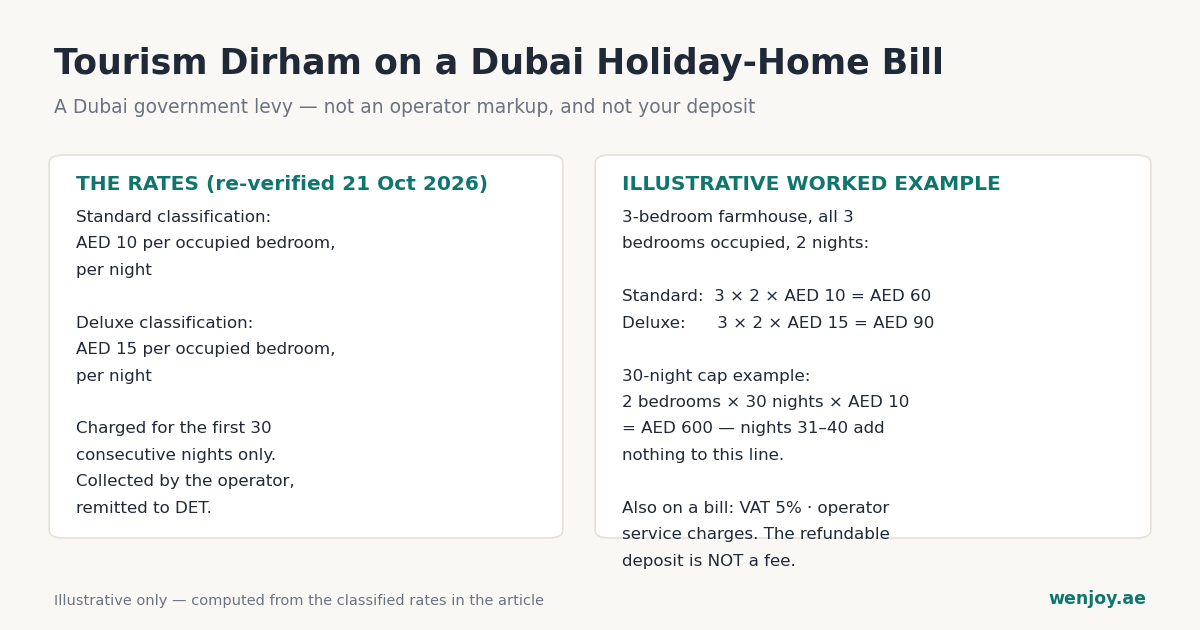
Tourism Dirham is a Dubai government levy charged at AED 10 per occupied bedroom per night for a Standard-classified holiday home, or AED 15 for a Deluxe-classified one, for the first 30 consecutive nights of a stay only. The operator collects it from you and remits it to Dubai's Department of Economy and Tourism (DET). It is not the operator's markup, and it is not your refundable security deposit.
Those rates are the classified rates as re-verified at the time of writing, on 21 October 2026, against multiple current sources describing the DET system, including guides citing Executive Council Resolution No. (2) of 2014. Rates are set by regulation and can change — check your own breakdown for the rate actually applied. If you are learning how to book holiday homes in the UAE, this page is the companion for the money lines.
How the maths works — per occupied bedroom, per night, capped at 30 nights
The unit of the levy is the occupied bedroom, not the person and not the whole property. A couple sharing one bedroom of a three-bedroom farmhouse does not pay for three bedrooms if only one is occupied — the charge follows occupied bedrooms. Equally, a large group using all the bedrooms pays on all of them. That single distinction answers most bill queries: if your Tourism Dirham line looks high, count occupied bedrooms first, then nights, then check whether the cap has been reached.
Hypothetical example 1 — a short stay. Imagine a 3-bedroom Dubai farmhouse classified Standard, with all 3 bedrooms occupied for 2 nights. The computation is 3 bedrooms × 2 nights × AED 10 = AED 60 of Tourism Dirham. If the same house were classified Deluxe, it would be 3 × 2 × AED 15 = AED 90. The example is illustrative only, computed from the re-verified rates above; it is not any listing's price and it says nothing about what any particular operator includes or itemises.
Hypothetical example 2 — the 30-night cap. Imagine a 2-bedroom Standard unit occupied for 40 consecutive nights. Tourism Dirham is charged only for the first 30 nights: 2 × 30 × AED 10 = AED 600, and nights 31 to 40 add nothing to this line. The cap is per stay, counted in consecutive nights from check-in. A genuinely new stay is a new computation; do not assume a mid-stay break resets or avoids the cap without asking the operator how they treat it, because the displayed market terms differ on extensions.
Classification is the other variable. Standard and Deluxe are DET classifications of the unit itself, not a description of how luxurious your weekend felt. You cannot choose the cheaper classification, and an operator cannot invent a third rate: the bill should show the rate that matches the unit's classification. If a breakdown shows a per-bedroom rate that is neither AED 10 nor AED 15 at the writing date, that is a legitimate question to put to the operator before paying.
The rest of the bill — VAT, service charges and what a total should include
Tourism Dirham is rarely the only line added to a nightly price. Two others appear across the Dubai market, and both need careful attribution. VAT in the UAE is charged at the general rate of 5%, and operator terms in the market apply it to rent, fees and services in the holiday-home context — Deluxe Holiday Homes' live terms, for example, state that a 5% VAT applies to rent, fees and services under UAE law, and Dream Inn's terms apply 5% VAT to its daily rate and service charge. Whether and how VAT appears on your booking depends on the operator and the booking, so look for it as a named line rather than assuming the nightly price already contains it.
Service charges are the operator's own line, not a government levy. Dream Inn's terms, again as a market example, state a service charge of 12% on services and the daily rate. Another operator may charge a different percentage, a flat cleaning or service fee, or none that is separately named. There is no single UAE service-charge rate for holiday homes, and this article does not invent one: read the percentage or amount on your own breakdown and ask what it covers if it is not labelled.
What should a total include? Before you confirm, the breakdown should let you separate four things: the nightly tier price multiplied by nights, the Tourism Dirham computation, any VAT and service lines the operator applies, and any optional extras you actually chose. Abu Dhabi's regulator makes the underlying principle explicit for its emirate — the DCT Abu Dhabi holiday-homes guideline requires guest terms to show taxes and fees separately before confirmation — and the same habit protects you in Dubai: if a total cannot be broken back into its lines, use the verify a listing before booking checklist and ask for the breakdown in writing before you pay. For context on where the nightly figure itself comes from in Dubai, see farmhouse rent in Dubai per night.
What is NOT a fee — the refundable security deposit
The security deposit is the line guests most often confuse with a fee, and the separation matters. A fee is money spent: Tourism Dirham goes to DET via the operator, and VAT and service charges are part of the price of the stay. A deposit is money held: on Wenjoy, the live security deposit policy states that the deposit is collected in cash by the vendor at check-in, held against damage, and returned in full at checkout if the property is left in good condition. It is not charged online, it is not revenue for the operator, and it does not belong in the same mental bucket as the nightly bill.
Two practical consequences follow. First, a deposit should never appear as a per-night charge — if it does, query it. Second, a deposit dispute is not a bill dispute: the deposit has its own return path, its own inspection at checkout, and its own evidence rules, which are covered in the deposit guidance this article links to rather than repeats. Cleaning charges, damage charges and other operator charges can also appear after a stay under an operator's own terms; those are contractual charges under the terms you accepted, not government levies, and they should be evidenced and itemised in the same way.
Outside Dubai — other emirates run different systems
Tourism Dirham, by that name and at those per-bedroom rates, is a Dubai levy. It does not automatically apply in Ras Al Khaimah, Fujairah, Sharjah, Umm Al Quwain or Ajman, and a farm stay in those emirates should not carry a Dubai Tourism Dirham line. If you see one there, ask the operator which levy they mean.
Abu Dhabi is the instructive contrast, stated carefully. It operates its own tourism-fee system under the Department of Culture and Tourism – Abu Dhabi, structured differently from Dubai's per-bedroom Dirham — current secondary sources disagree on its present percentage following the 2023 fee revision, so this article publishes no Abu Dhabi percentage as fact. What is solid, from the DCT guideline, is the principle: guest terms must state tax and fee terms before confirmation. In every emirate, the fee system is local and the breakdown is your evidence.
Checking your own bill — three questions before you pay
First, which classification is this unit, Standard or Deluxe, and does the per-bedroom rate on my breakdown match it? Second, how many occupied bedrooms and how many chargeable nights — capped at 30 — produce the Tourism Dirham total shown? Third, which of the remaining lines are government levies, which are the operator's own charges, and is the refundable deposit shown separately from money spent? An operator who can answer those three questions in writing has given you a checkable bill. If anything remains unclear on a Wenjoy booking, contact Wenjoy before paying rather than after.
Frequently Asked Questions
What is the Tourism Dirham in Dubai? A Dubai government levy on hotel and holiday-home stays, collected from guests by the operator and remitted to the Department of Economy and Tourism (DET). For holiday homes it is charged per occupied bedroom per night at the unit's classification rate, as re-verified at the writing date: AED 10 for Standard, AED 15 for Deluxe.
How much is the Tourism Dirham for a holiday home — per person or per bedroom? Per occupied bedroom, not per person. A worked hypothetical: 3 occupied bedrooms, Standard classification, 2 nights = 3 × 2 × AED 10 = AED 60. Only occupied bedrooms count, and only the first 30 consecutive nights are charged.
Why is Tourism Dirham only charged for 30 nights? Because the levy is capped by regulation at the first 30 consecutive nights of a stay. On a 40-night stay in a 2-bedroom Standard unit, the charge stops at 2 × 30 × AED 10 = AED 600; nights 31–40 add nothing to that line.
Is Tourism Dirham the same as the security deposit? No. Tourism Dirham is a fee — money spent and remitted to DET. The security deposit is refundable money held against damage; on Wenjoy it is collected in cash at check-in under the live security deposit policy and returned at checkout if the property is left in good condition.
Does Tourism Dirham apply to farm stays in Hatta? Hatta is in the Emirate of Dubai, so a licensed Dubai holiday home there sits inside the Dubai system this article describes. This article does not assert how any individual Wenjoy listing or booking itemises the levy — check the breakdown on your own booking and ask the operator if the line is not shown.
Do other emirates charge a tourism fee on holiday homes? Other emirates run their own systems rather than Dubai's per-bedroom Dirham. Abu Dhabi, for example, operates a separate DCT tourism-fee system for holiday homes; current secondary sources disagree on its present percentage after a 2023 revision, so this article does not state a figure — verify the current treatment with DCT Abu Dhabi for an Abu Dhabi booking.
Farmhouses to book in Dubai
Verified private stays on Wenjoy — live prices, book online or send an inquiry.


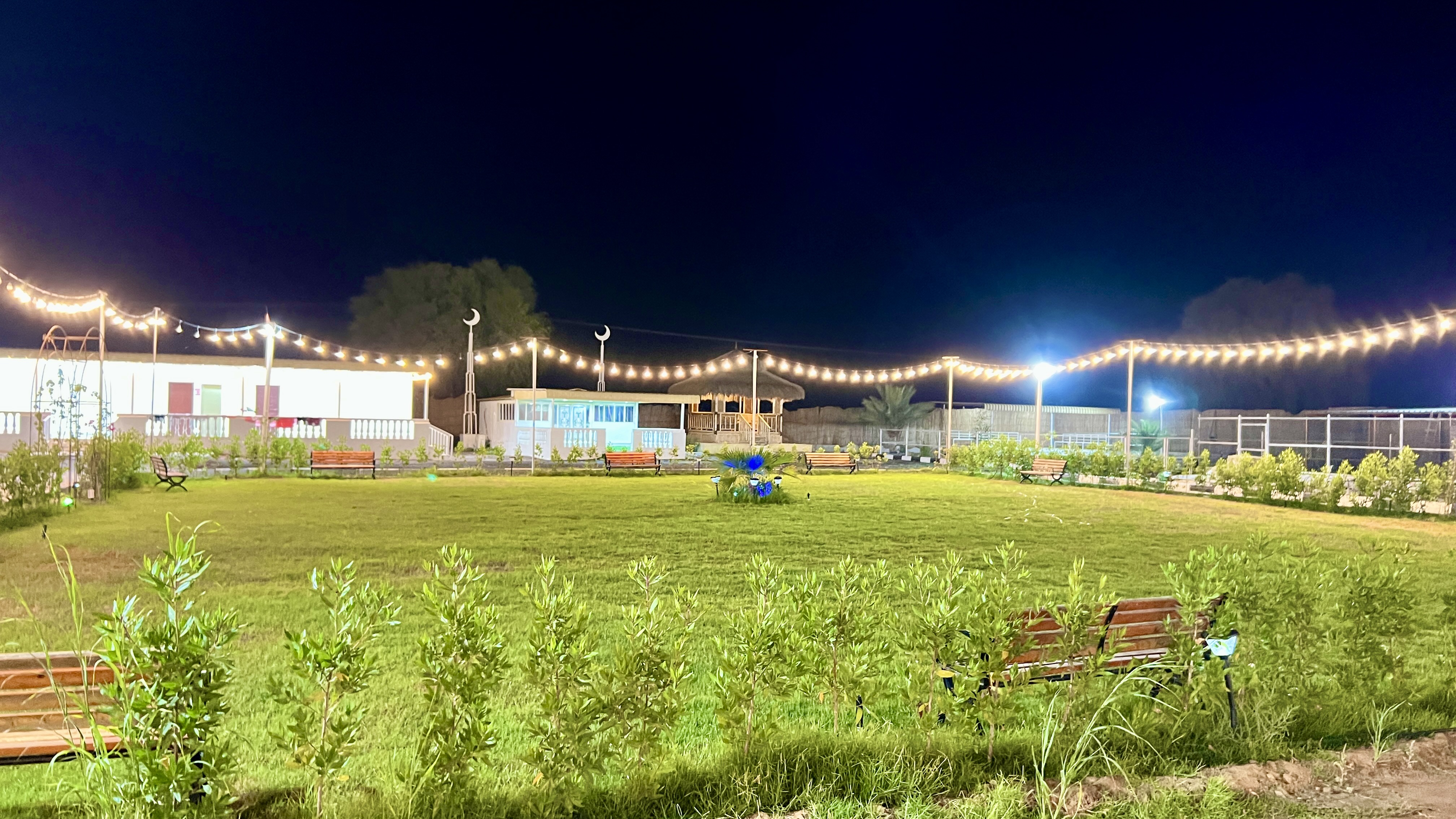
Ultimate Family Adventure Farm
Hatta, Dubai, UAE

5Bedroom

9Bed

5Bath
Ultimate Family Adventure Farm
5 Bedrooms
9 Beds
5 Baths
25 Guests


Luxury Farmhouse With Football Ground
Hatta, Dubai, UAE
4Bedroom
12Bed
4Bath
Luxury Farmhouse With Football Ground
4 Bedrooms
12 Beds
4 Baths
35 Guests


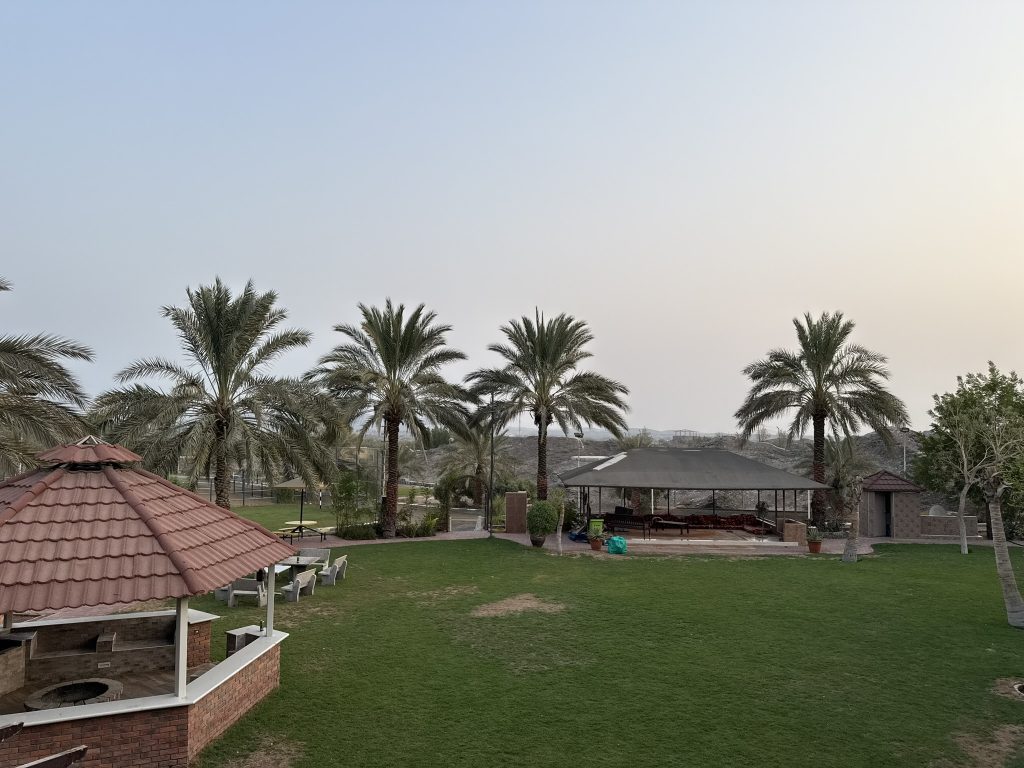
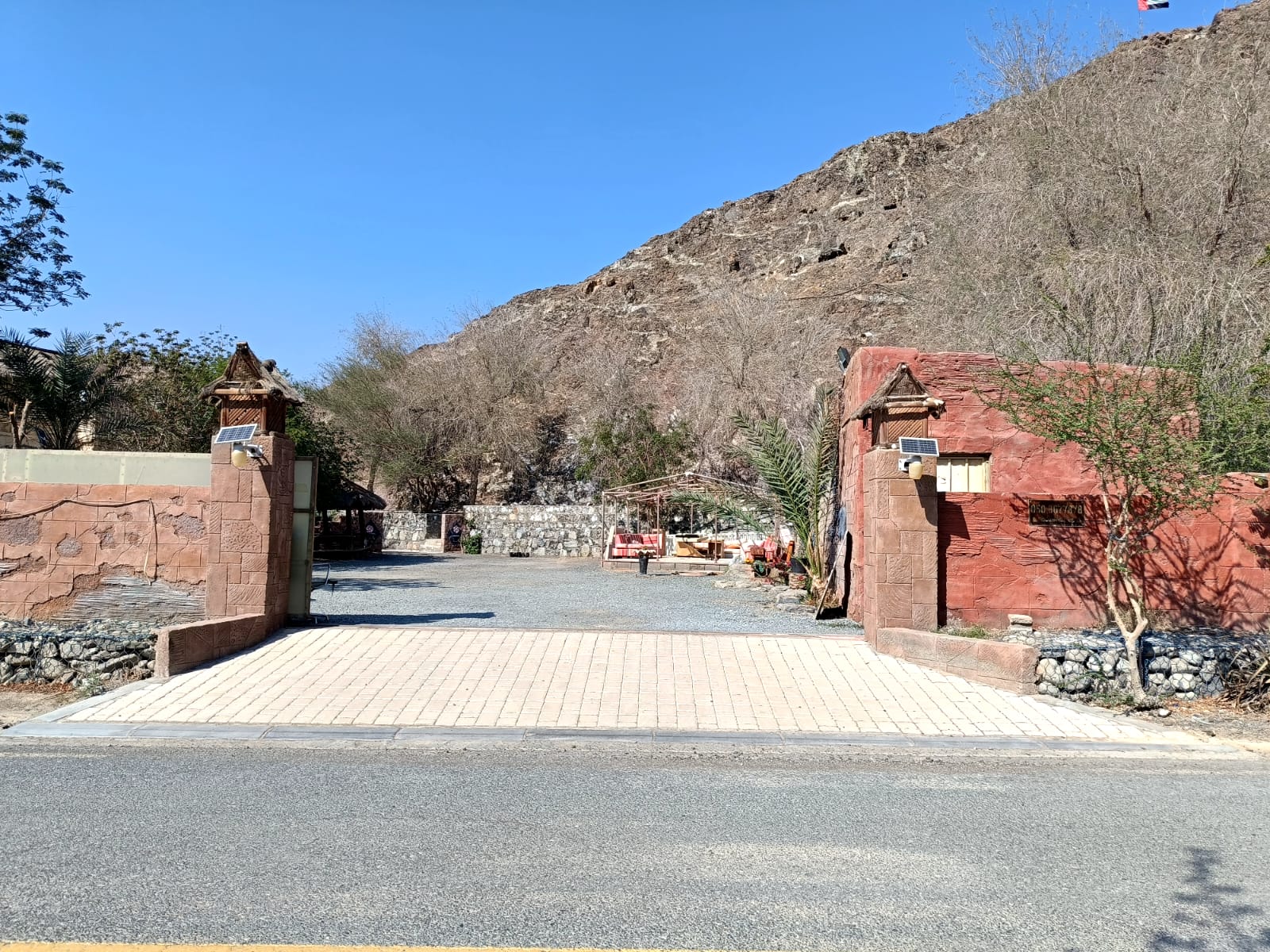
Hillside Farmhouse With Grand Majlis
Hatta, Dubai, UAE
3Bedroom
7Bed
4Bath
Hillside Farmhouse With Grand Majlis
3 Bedrooms
7 Beds
4 Baths
25 Guests

--1777464480-thumb.webp)
--1777464475-thumb.webp)
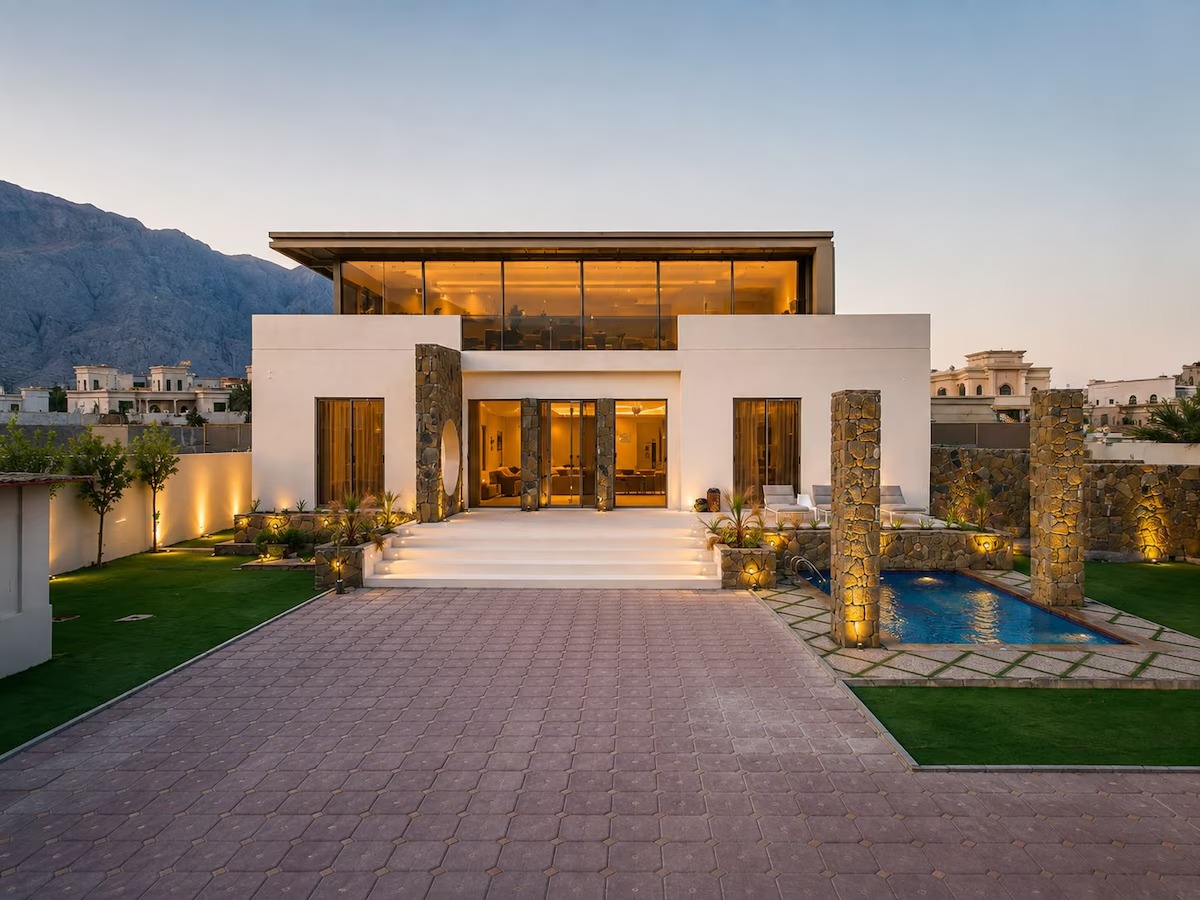
Luxury Mountain Farmhouse in Hatta
Hatta, Dubai, UAE
3Bedroom
6Bed
4Bath
Luxury Mountain Farmhouse in Hatta
3 Bedrooms
6 Beds
4 Baths
15 Guests


Search
Recent Posts
Top Farmhouse Stays



Book a UAE Farmhouse
Verified hosts, clear AED pricing, local support. From private-pool villas to group-size farmhouses across all 7 Emirates.
Browse Farmhouses →