


 Wenjoy
16 Aug 2026
Farmhouse
Wenjoy
16 Aug 2026
Farmhouse
Book a Farmhouse BBQ Area That Works for Your Group
Choose a farmhouse BBQ area by matching the actual cooking setup to your meal — not by trusting one photograph of a grill. Before paying, confirm the grill type, fuel, prep surface, water, lighting, shade, tools and clean-up duties in writing. Then plan quantities, timing and the route between grill, majlis and pool. This guide gives you the full method.
What separates a working BBQ area from a photogenic one?
A working group BBQ area is a relationship between six things: cooking surface, preparation space, serving space, water, light and waste. A visible grill in a photo establishes none of that. It can't tell you whether the unit takes charcoal or gas, whether there's a lit prep table beside it, or where twenty finished platters are supposed to wait while the next round cooks.
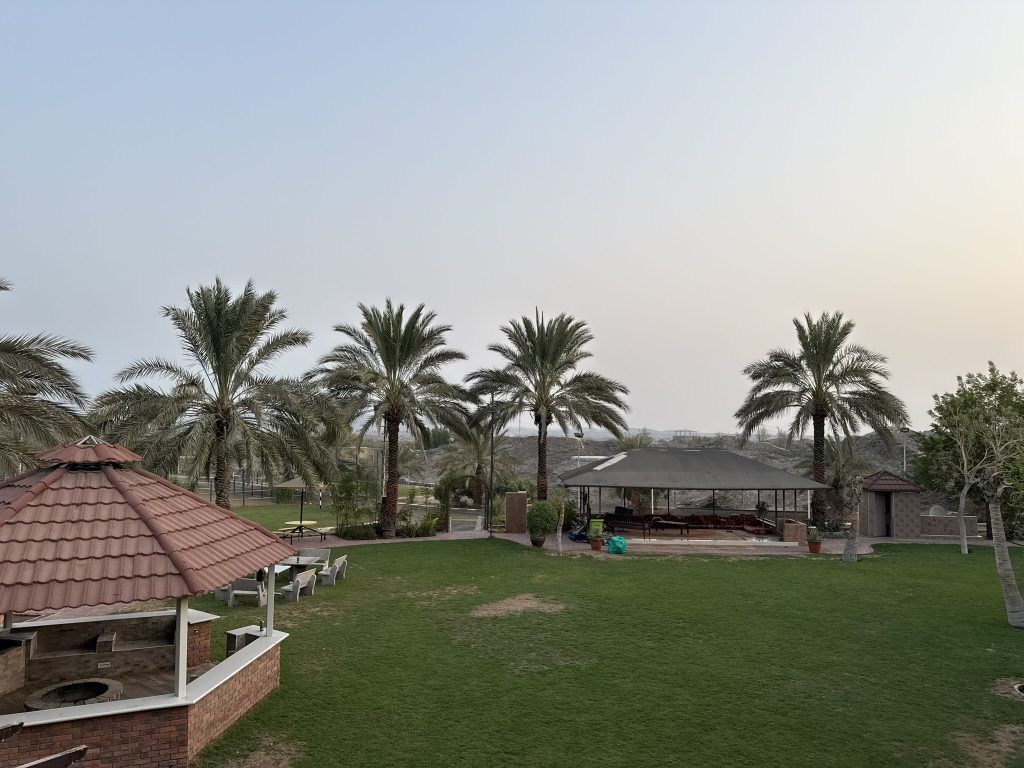
Read the amenity description, then interrogate the photos: where would raw food sit? How does the cook reach water? Where do finished platters wait? Do guests heading to the pool cross the same narrow space the cook is carrying hot trays through? Photos answer layout questions; only the host answers equipment questions.
Keep three labels beside every shortlisted property: confirmed, unclear, unsuitable. Use "confirmed" only when the answer names the actual facility. "BBQ available" stays "unclear" until you know whether that's a built-in grill, a portable unit or just a patch of garden where cooking is tolerated. Mark a property "unsuitable" when a confirmed limitation breaks your plan — an unlit cooking position when dinner must be prepped after dark, for example.
If the gathering is really about the meal, start from properties built for it: the private green farm party venue is designed around group events, and our private BBQ villa guide covers the villa end of the market.
What should you confirm with the host before booking?
Send these questions together, so the answers refer to the same property and date. This is your BBQ-area fitness test:
- Cooking unit: What type of BBQ is supplied — built-in, kettle, gas — and is there a current photo showing the cooking surface and where it stands?
- Fuel: What fuel does it take, and who supplies it — host or guest? "Fuel provided" is less useful than the named fuel and quantity.
- Preparation: Is there a clean, stable prep surface beside the cooking position? Reject any plan with nowhere safe to handle raw food.
- Water and waste: Where's the nearest usable water point, and what bins, bags and cleaning tools are provided? Clarify ash and grease disposal.
- Lighting and shade: Is the cooking surface lit after dark? What shades the cook during your prep hours? A shaded afternoon photo proves nothing about evening light.
- Tools: Are tongs, skewers, trays, heat-resistant gloves and cleaning brushes supplied? Ask for an itemised list, not "fully equipped."
- Permission: Must guests use only the supplied unit? Are guest-brought grills, fire pits or open fires allowed? (Many UAE properties prohibit open fires outright — and note that barbecuing in undesignated public areas can draw municipal fines, so keep the cookout on the property.)
- Close-down: What must guests cool, clean, bag or remove — and is any part of the deposit tied to it?
If a decision-changing answer stays vague, keep the property off the payable shortlist. For the wider booking process, our farmhouse booking checklist covers deposits, capacity and house rules, and the verify-before-you-book checklist shows how to confirm listing claims.
What does the farmhouse supply — and what do you bring?
Turn the host's answers into a two-column packing plan. Never buy charcoal for an unidentified grill, and never arrive with a second grill the property won't allow.
| Item | If the property supplies it | If not, the group brings |
|---|---|---|
| Cooking unit | Confirm type + photo | Only a permitted alternative — ask first |
| Fuel | Record type and quantity | Buy only the accepted type |
| Tongs, skewers, trays, gloves | Itemised list | Assign missing tools to specific people |
| Prep surface | Record its position | A stable portable table, only if approved |
| Serving platters and covers | Record what's there | Clean food-service items, kept separate from raw-food gear |
| Waste bags, bins, cleaning tools | Record what's provided | Assign the gaps; clarify ash handling |
Split the final packing list into three: food, reusable group equipment (cool boxes, serving dishes, lights), and property-dependent supplies (fuel, charcoal, firelighters). The third list stays blank until the host confirms the setup. This one discipline prevents the classic failure: a car boot full of charcoal for a gas grill. When comparing holiday-home amenities, treat the BBQ setup as the single most variable item on the list.
Stock up before you leave the city — rural farmhouses can sit 20+ minutes from a proper supermarket. Lulu, Carrefour and the city's halal butchers cover meat; for marinated cuts in bulk, order from a butcher a day ahead. Our family weekend getaway with BBQ has more on planning the food run.
From our booking team: "The groups that eat well are the ones that confirmed the grill type before shopping. The groups that eat late are the ones who discovered a tiny kettle grill at 6pm for 25 people. One message to the host saves the whole evening." — Wenjoy group-stay specialists
How much food do you need for a group BBQ?
Work from two headcounts, not one. The daytime meal count drives food, seating and waste; the overnight count drives bedrooms. Never plan the meal off the smaller overnight number — that's how 22 diners get food for 12.
Use these planner's starting points (adjust to your group's appetite):
- Meat: ~350g raw weight per adult, ~175g per child. For 20 adults that's 7kg — split across chicken, kofta/mince and one showpiece (whole fish, ribs).
- Bread and rice: 1–2 khubz or rolls per person, plus a tray of rice or machboos base for 60% of the group.
- Salads and sides: 2–3 salads at ~150g per person total; hummus, fattoush and tabbouleh travel well in UAE heat.
- Drinks: ~1.5 litres per person for an evening cookout (more in shoulder-season warmth); ice at 1kg per 4 people.
- Charcoal (if applicable): ~1.5–2kg per 10 people for a 3-hour cook.
Now convert portions into grill rounds: sketch your menu items onto the grill's cooking surface (from the host's photo or dimensions) and count how many portions fit per batch. Divide portions needed at once by portions per batch, round up. Sixteen first-serving portions on a grill that holds eight per batch = two rounds. If the rounds don't fit your evening, shrink the grilled menu, serve a cold first course, or ask whether a second approved unit exists.
Getting the headcount-to-bedroom maths right matters too — see our guide to group size and sleeping arrangements, and for big gatherings generally, group accommodation in the UAE.
How do you time a group cookout in the UAE?
Work backward from serving time. The October–April outdoor season is your planning window; summer cookouts should be indoor-led or kept to late evening, since interior highs push past 45°C (National Center of Meteorology).
A backward run-sheet for an 8:00pm serving target:
- 8:00pm — serving target (set around prayer times and the group's schedule).
- Final grill round — placed so the last hot food lands just before serving.
- Earlier rounds — using your calculated batch count; charcoal needs 30–45 minutes to reach cooking heat, gas 10–15.
- Equipment prep — lighting and heating the grill, only by the method confirmed for that unit.
- Food prep — split into what travels ready (marinated, chopped, in cool boxes) and what must happen at the property.
- Serving setup — clean platters, covers, utensils staged; one person owns the route from grill to table.
- Close-down — cooling, cleaning and waste per the host's confirmed duties.
Two food-safety rules anchor the timing. Keep cold food cold and hot food hot: bacteria multiply fastest between 5°C and 60°C (the WHO "danger zone"), so marinated meat travels in cool boxes with ice, not in a warm car boot, and cooked food shouldn't sit out more than two hours in UAE warmth. And never put cooked food back on the platter that held it raw.
For occasion planning around the meal — birthdays, reunions — see farmhouse birthdays and celebrations and villas for reunions.
How do the BBQ, majlis and pool work together?
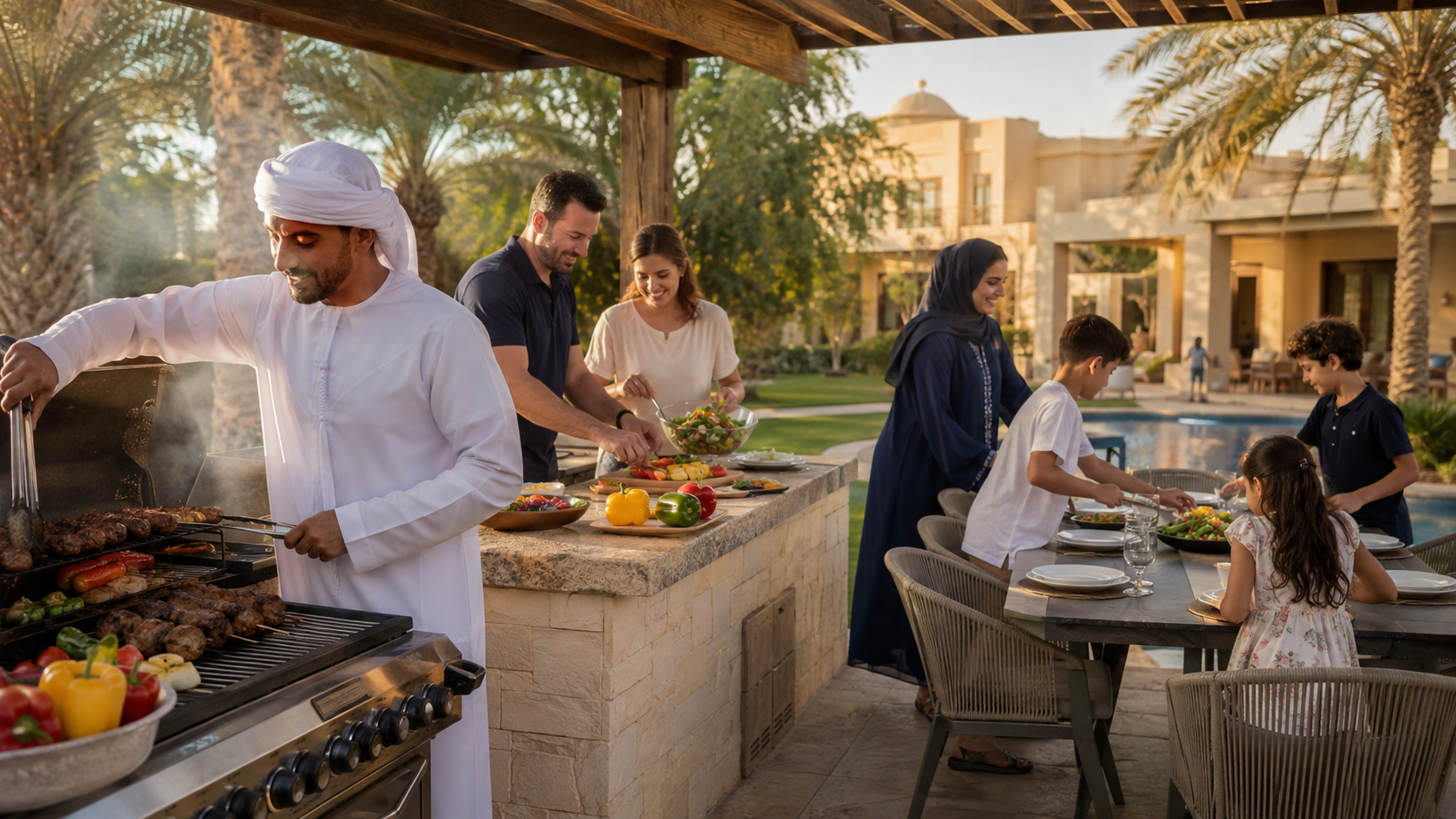
Draw five boxes: BBQ, raw-food prep, clean serving area, majlis/dining area, pool. Then draw three routes: the cook's route to water, the finished-platters route to the table, and the guests' route to the pool and toilets.
A workable plan keeps swimmers and small children off the hot-food route, and keeps raw ingredients away from clean platters. The majlis is the social heart — don't let it become the prep station, the serving counter and the traffic corridor all at once. If smoke drifts into the seating, pause and use only a host-approved alternative position; never casually relocate hot equipment. Ask upfront whether the unit may be repositioned within an approved area, and don't promise a smoke-free majlis based on a still photo and assumed wind.
Properties with a grand majlis handle this best, because the seating area is large enough to zone separately from the cooking. For friend-group weekends built around the grill, our friends' getaway farmhouse guide is worth a read.
Ready to plan it? Browse Wenjoy's farmhouse collection and filter for BBQ amenities — event-ready options like the private green farm party venue and the grand palm tree garden farmhouse are built for exactly this.
A worked example: 22-person farmhouse cookout
Twenty-two daytime diners, twelve overnight guests, sixteen people wanting the first hot serving at 8:00pm. The organiser sketches the menu onto the grill photo: eight portions per batch, so two rounds for the first serving. The sketch goes to the host with one question — does this photo show the current setup?
The supplied-vs-bring checklist is completed from the host's reply. No fuel is bought until the unit is identified. If there's no prep table, the organiser asks whether a stable portable table is allowed — without an approved solution, the property fails the fitness test.
On the day: one adult owns the hot-food route, another keeps casual traffic clear while platters move. Charcoal is lit by 6:30pm (45 minutes to heat), round one hits the grill at 7:15pm, round two at 7:40pm, serving at 8:00pm. Cool boxes keep the marinated meat below 5°C until it cooks; close-down follows the host's confirmed duties. Every number here is a planning input for this scenario — run your own maths for your group. First time organising at this scale? Walk through the first group booking guide and how to book group villas first.
Frequently asked questions
Do UAE farmhouses have BBQ areas for groups?
Most do — a BBQ area alongside the pool, garden and majlis is standard on group-oriented farmhouses. But "BBQ area" ranges from a built-in grill station to an empty corner where cooking is tolerated. Confirm the unit type, fuel, tools and permission in writing before booking.
What fuel do farmhouse BBQs use — charcoal or gas?
Both exist. Charcoal is traditional and common at rustic properties; gas units appear at newer, premium ones. Never assume — buy only the fuel type the host confirms, and ask who supplies it. Charcoal needs 30–45 minutes to reach cooking heat; gas needs 10–15.
How much meat should I buy per person for a group BBQ?
Plan roughly 350g of raw meat per adult and half that per child, plus bread, salads and sides. For 20 adults that's about 7kg of meat. Adjust for your group's appetite, and remember the grill's batch capacity — not the shopping list — sets how many cooking rounds you'll need.
Can we bring our own grill to a farmhouse?
Only with the host's explicit permission. Many properties restrict guests to the supplied unit and prohibit guest-brought grills, fire pits or open fires. Ask in writing before you load the car — arriving with a banned grill is a fast route to a forfeited deposit.
How do we keep food safe at an outdoor BBQ in the UAE?
Keep raw meat in cool boxes with ice until cooking (bacteria multiply fastest between 5°C and 60°C, per WHO guidance), don't reuse platters that held raw meat for cooked food, and don't leave cooked food sitting out more than about two hours in the warmth. In summer, shift the cookout to late evening or indoors.
What's the best time of year for a farmhouse BBQ?
October to April, when evenings suit outdoor cooking and dining. Summer cookouts are possible but need shade, lighting, strong AC backup and a late-evening schedule. Book winter weekends early — they're peak demand across the UAE's farm stays.
Who handles clean-up after the BBQ?
It varies by property and is sometimes tied to the deposit. Confirm in writing what guests must cool, clean, bag or remove — including ash and grease disposal — and what the host or cleaning crew covers. Get this answer before paying, not at midnight after the party.
The takeaway
A great group BBQ at a farmhouse isn't luck — it's a confirmed grill, a two-headcount shopping plan, a backward-timed evening, and a majlis the smoke never reaches. Run the fitness test before you pay, and the cookout runs itself.
Make it happen: browse Wenjoy's farmhouses with BBQ areas at clear live prices — or talk to our team and we'll match an event-ready property like the private green farm party venue to your group and date.
Frequently Asked Questions


Search
Recent Posts

Top Farmhouse Stays


Book a UAE Farmhouse
Verified hosts, instant booking, AED pricing. From private-pool villas to group-size farmhouses across all 7 Emirates.
Browse Farmhouses →