


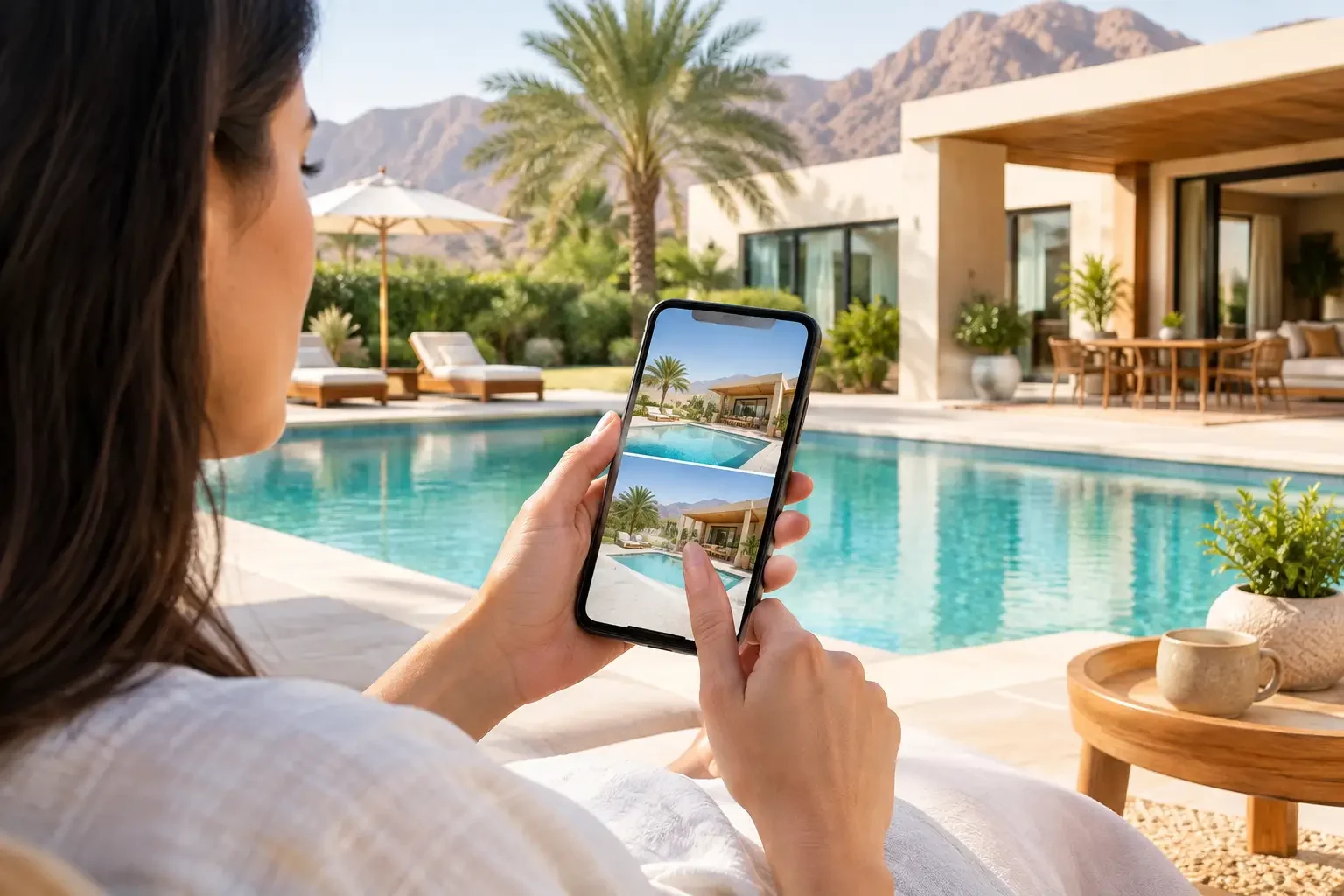
 Wenjoy
28 Sep 2026
Holiday homes
Wenjoy
28 Sep 2026
Holiday homes
How to Verify Rental Photos Before You Book in the UAE
Verify rental photos in about ten minutes: run a reverse-image search, cross-check the listing details, and ask the host three pointed questions. Most UAE holiday-home scams collapse under that scrutiny, because fraudulent listings reuse stolen or AI-generated photos. Here is the exact process that works.
Why Do Rental Photos Deserve a Closer Look?
Photos sell the stay, and scammers know it. A villa that looks perfect for a family weekend in Hatta or a friends' getaway on Al Marjan Island can be nothing more than borrowed pictures attached to a bank account. Photo fraud is not a niche problem: McAfee's 2025 travel research found that one in three travellers has faced some form of travel scam, and manipulated or misleading accommodation listings rank among the most common tricks, affecting 15% of scam victims (businesswire.com).
The same research found fake vacation rental listings specifically trap 10% of victims. The money involved is serious. The FBI's Internet Crime Complaint Center recorded $173.6 million in reported real-estate and rental fraud losses in 2024, and the Better Business Bureau logged $37 million in rental fraud across 9,403 travel-related complaints in 2025 (weneedavacation.com).
In the UAE, the risk spikes around Eid holidays, National Day weekends, and the December–March peak season, when demand outruns supply and guests book in a hurry. That urgency is exactly what fraudsters exploit. Spending ten minutes on photo verification is the cheapest travel insurance you will ever buy.
Before you start checking images, it helps to understand how to book holiday homes in the UAE safely and why verified holiday homes in the UAE are worth choosing. When you are ready, browse verified stays with real, checked photos instead of gambling on a stranger's gallery.
How Can You Spot a Fake or Stolen Rental Photo?
Start with reverse-image search. It is free, takes seconds, and catches the most common scam outright.
- Run every key photo through Google Lens. Save or screenshot the pool, exterior, and living-room shots, then drop them into Google Lens or TinEye. If the same "private villa in Dubai" photo appears on a real-estate listing in another country, a Pinterest board, or a hotel website, walk away.
- Check for AI-generated imagery. As Collin Czarnecki, a researcher studying travel fraud, told ConsumerAffairs: "Scammers who once needed technical skill or resources can now generate convincing fraud in minutes due to AI." AI-made interiors often have warped furniture edges, impossible window reflections, and lighting that doesn't match the shadows (consumeraffairs.com).
- Look for the same room photographed as two rooms. Count bedrooms by comparing wall colours, headboards, windows, and rugs across the gallery. Scam galleries often show one stylish bedroom from several angles to imply a four-bedroom villa.
- Inspect the photo metadata. Right-click and check properties on desktop images when available. Real host photos usually carry phone-camera EXIF data with dates. Stripped metadata on every image is not proof of fraud, but combined with other red flags it adds up.
A legitimate host in Ras Al Khaimah or Fujairah will have nothing to hide from these checks. If a listing fails even one of them, treat it as a hard stop and keep looking. Our listing verification checklist walks through these steps in order, and our guide to Airbnb alternatives in the UAE explains which platforms apply the strictest photo standards.
What Are the Red Flags of a Misleading Listing?
Even when photos are real, the listing around them can mislead. Watch for these warning signs, each of which is common in UAE rental fraud reports:
- A price far below the area's market rate. A "luxury" five-bedroom villa with a private pool in Palm Jumeirah listed at AED 800 a night is not a bargain; the market simply doesn't price that way. Compare against verified Dubai properties before trusting an outlier.
- No exterior or entrance photos. A real villa can be photographed from the street or the gate. Listings that show only interiors may be hiding that the property doesn't exist at the claimed address, or that the "private pool" belongs to a shared compound.
- Vague location. "Near Dubai Marina" without an area name, or a pin dropped in the sea on the map, is a classic dodge. Ask for the community name: Springs, Al Barsha, JVC, Mirdif, Hatta, Al Hamra Village. Then check it on a map yourself.
- Pressure to pay off-platform. "Bank transfer only, pay today or lose the dates" is the single biggest red flag in rental fraud. Legitimate UAE operators accept card payments through their platform. In the UK alone, holidaymakers lost £11 million to travel scams in 2024, with the average victim losing around £1,844, and off-platform payment was a factor in a large share of cases (cybersecurity-insiders.com).
- The host refuses a video call. Any genuine host or agency can do a two-minute WhatsApp video walkthrough. Refusal is disqualifying.
If the listing survives this screen, read the cancellation terms before you pay anything and compare the listed amenities against the photos. A promised BBQ, outdoor cinema, or maid's room should be visible or explicitly described, not just implied.
How Do You Verify a Property Without Visiting It?
You don't need to drive to Umm Al Quwain to confirm a farmhouse is real. Use these remote checks:
Ask for a live video walkthrough. Not a pre-recorded tour — a live call where you ask the host to show you something specific, like the view from the master bedroom window or the pool pump room. Scammers using stolen photos cannot do this. Genuine hosts do it routinely; on Wenjoy, our team does these walkthroughs as part of verification.
Cross-check the location. Drop the community name into Google Maps and switch to satellite view. A villa with a "huge private garden" should show a proportionate plot. In Dubai, ask for the DTCM holiday-home permit number — every legal short-stay listing in the emirate must display one, and you can verify the operator against Dubai's Department of Economy and Tourism records. In Abu Dhabi, short stays fall under the Department of Culture and Tourism's licensing framework.
Read the reviews like an investigator. Real reviews mention specific details: the drive from Dubai, the supermarket in Hatta, the water temperature in February. Fake reviews are vague ("nice place, good stay") and often cluster within the same week. Also check the reviewer's history — one-review accounts praising a single property are worthless as evidence.
Match capacity to photos. A villa sleeping 14 should show enough beds, bathrooms, and dining seats for 14 people. Count them. Our guide to checking property capacity shows how to do the bedroom math, and the farmhouse booking checklist covers the questions groups forget to ask.
What Should a Trustworthy Listing Include?
A listing that wants your money should make verification easy, not hard. Expect all of the following:
- Room-by-room photo coverage: exterior, living area, kitchen, every bedroom, bathrooms, pool, and parking. Ten angles of one room is a warning sign; one photo per real room is the standard.
- Consistent details: bedroom count, bed configuration, bathroom count, and maximum occupancy stated in text and supported by the photos.
- A named operator with real contact details: a UAE phone number, a trade licence name, and reviews on more than one platform.
- Clear payment and cancellation terms: what the deposit is, when the balance is due, and what happens if you cancel. Anything vague here will become a dispute later.
"The listings that cause problems are almost never the ones with too much information. It's the thin ones — six photos, two lines of description, and a host who only wants to talk on WhatsApp. When a guest sends us a suspicious listing, the photos are usually stolen within the first reverse-image search." — Wenjoy booking specialist, who verifies farmhouse and villa listings across Dubai, RAK, and Hatta
Midway through your search, remember the goal: you are not just finding a pretty villa, you are confirming a real one. Every property on Wenjoy's verified collection has been physically checked by our UAE team — photos, capacity, pool, and location — before it goes live.
Why Does Booking a Verified Platform Lower the Risk?
Individual verification works, but it puts all the labour on you, every single trip. A verified platform shifts that burden to people who do it full-time. Wenjoy operates 150+ farmhouse, villa, and holiday-home stays across the UAE under Suhoob Holiday LLC, and every listing is checked in person: the team visits the property, photographs it, confirms the bedroom count and amenities, and re-verifies on an ongoing basis.
That matters because the most convincing scams are not sloppy. AI-generated listings now include fake reviews, fake host profiles, and even fake video tours stitched from stock footage. A single traveller booking once a year cannot keep up with those tactics; a verification team handling hundreds of check-ins can.
Booking verified also protects your payment. Card payments through a proper platform create a transaction record your bank can act on. A wire transfer to a personal account does not. If something goes wrong, verified holiday homes in the UAE come with a real company, a real office, and a support line — not a disconnected number.
Frequently Asked Questions
Can I trust professional listing photos?
Professional photos are usually trustworthy when they come with a complete gallery and consistent listing details. Wide-angle lenses make rooms look larger, which is normal in real-estate photography, but the rooms, pool, and views should be real. Run a reverse-image search on the hero shots; if they appear only on that listing, you are likely looking at genuine photography.
How do I do a reverse-image search on my phone?
Screenshot the listing photo, open the Google app, tap the camera (Lens) icon, and upload the screenshot. Google will show visually similar images and the pages they appear on. TinEye.com works the same way in a mobile browser. Check at least the exterior, pool, and living-room photos — those are the images scammers steal most often.
What should I do if the host refuses a video call?
Do not book. A live video walkthrough is a reasonable, standard request, and every legitimate UAE host or agency can arrange one within a day. Refusal, excuses, or offers of "more photos instead" are among the strongest scam indicators. Move on to a verified listing where walkthroughs are part of the process.
How do I check a Dubai holiday home's DTCM permit?
Ask the host or platform for the DTCM (Department of Economy and Tourism) permit number for the unit. Legal short-stay operators in Dubai must hold one and usually display it on the listing. If the host cannot provide it, or the number doesn't check out, the listing is operating outside the regulated system and you have no consumer protection if things go wrong.
I already paid a deposit to a suspicious listing. What now?
Act immediately. Contact your bank or card issuer to dispute the transaction — card payments can often be reversed, while wire transfers usually cannot. Save every message, screenshot the listing, and file a report with Dubai Police's eCrime portal (or the police of the relevant emirate). Then report the listing to the platform where you found it so it can be removed before others pay.
Do verified platforms cost more than booking direct with a host?
Sometimes marginally, never dramatically — and the difference buys verification, secure payment, and someone to call at 9pm when the AC fails. An unverified "direct deal" that is 30% cheaper usually reflects 100% of the risk sitting with you. For peak dates like Eid or New Year, when scam activity is highest, the verified route is the rational choice.
Book the stay you actually saw in the photos. Every farmhouse, villa, and holiday home on Wenjoy is physically verified by our UAE team before listing — real photos, real capacity, real location. Browse verified stays across Dubai, Abu Dhabi, RAK, Fujairah, and Hatta and book with confidence.
Frequently Asked Questions


Search
Recent Posts
Top Farmhouse Stays



Book a UAE Farmhouse
Verified hosts, instant booking, AED pricing. From private-pool villas to group-size farmhouses across all 7 Emirates.
Browse Farmhouses →